Programme Overview
The GENIUS training programme aims to develop a new generation of interdisciplinary researchers equipped to address scientific, technological, and societal challenges related to energy geostructures and geothermal energy systems. The programme combines advanced scientific education with industry exposure and transferable skills development, preparing Doctoral Candidates (DCs) for careers in both academic and non-academic sectors.
Training Objectives
The programme is designed to:
-
Provide advanced knowledge in geotechnical engineering, geothermal systems, and energy technologies
-
Develop interdisciplinary competences combining geomechanics, energy systems, and data-driven approaches
-
Strengthen intersectoral collaboration through industrial partnerships and secondments
-
Equip DCs with transferable skills including communication, project management, entrepreneurship, and career development
-
Foster innovation, research excellence, and employability
-
Promote Open Science, research integrity, and ethical research practices in line with MSCA principles
Training Strategy
GENIUS adopts a structured and holistic training approach that combines:
-
Network-wide Training Schools, Workshops, and Conferences
-
Local training at host institutions
-
Academic and industrial secondments
-
Hands-on learning through site visits and case studies
-
Blended learning formats integrating online and face-to-face activities
The programme is built around interdisciplinarity, intersectoral collaboration, progressive learning, flexibility, and practical experience.
Programme Structure
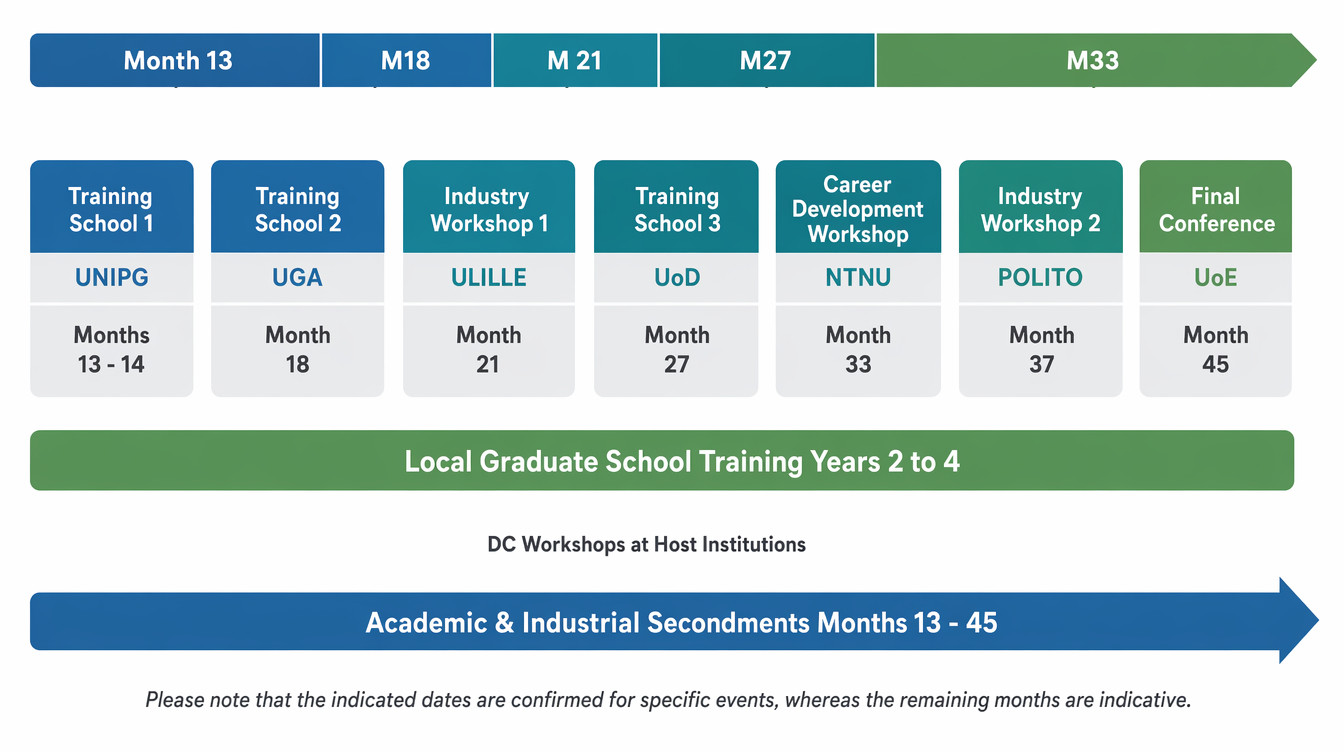
The training programme provides a balanced and progressive learning pathway throughout the doctoral journey. It integrates:
Training activities are aligned with the progression of each DC, moving from foundational knowledge towards specialised expertise, independent research, and dissemination.
Expert scientific training is tailored to each DC’s research topic, professional profile, and career ambitions, while transferable skills training supports leadership, communication, and innovation capacity across sectors.
Training Event Overview
Training School 1 (TS-1) – Basic and expert scientific training, transferable skills, and EGs Graduate Course
Training School 2 (TS-2) – Basic and expert scientific training, transferable skills, and CETP LEG-DHC programme
Industry Workshop 1 (IW-1) – Applied industrial and sustainability training
Training School 3 (TS-3) & Midterm Meeting
Career Development Workshop (CDW) – Career planning, networking, and dissemination skills
Industry Workshop 2 (IW-2) – Industry collaboration and innovation activities
Final Conference (FC)
Training Schools
Three Training Schools provide progressive scientific and transferable skills training in areas including:
-
Geotechnics and soil mechanics
-
Geothermal systems and energy geostructures
-
Energy modelling and thermodynamics
-
Machine learning applications
-
Thermomechanical behaviour of soils
-
Sustainability and low-carbon energy systems
The first two Training Schools follow a blended format combining face-to-face and online learning.
Industry Workshops
Industry Workshops provide practical and applied perspectives through:
-
Life cycle assessment and sustainability analysis
-
Industrial case studies
-
Innovation and entrepreneurship in energy systems
-
Environmental impact assessment
Career Development Workshop
The Career Development Workshop focuses on:
-
Networking and career planning
-
Interview preparation
-
Research impact and dissemination
-
Energy policy and stakeholder engagement
Final Conference
DC-Organised Event
The Final Conference will be organised by the DCs and will provide an open forum to present research outcomes, strengthen collaborations, and explore innovation and commercialisation opportunities with academic and industrial stakeholders.
Local Graduate School Training
Host institutions will provide complementary local training covering:
Research skills
-
Scientific writing and publishing
-
Literature review methods
-
Knowledge transfer activities
Communication skills
-
Presentation and communication skills
-
Language training where applicable